
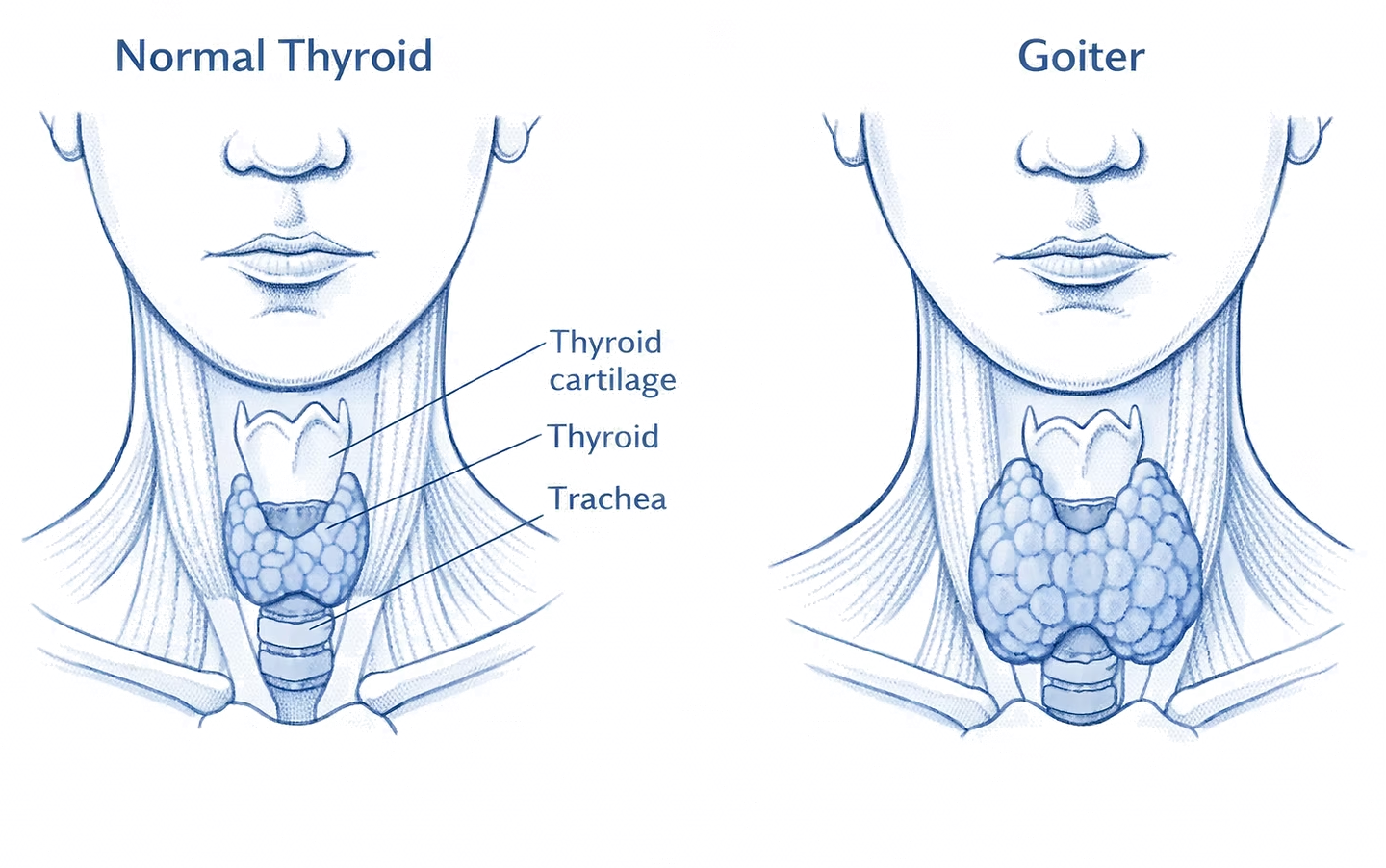
Thyroid growths

Thyroid growths are common and include thyroid nodules, cysts, goitre, and thyroid tumours. They arise within the thyroid gland, which is located at the front of the neck and regulates metabolism through thyroid hormone production.

Most thyroid growths are benign, but assessment is important to exclude malignancy, especially if the growth is enlarging, firm, painful, associated with swallowing or breathing difficulty, or causing voice changes.

What to expect

Before Your Surgery

  • Authorization will be arranged by the rooms or hospital staff.
  • Fasting:
  • No solid food for 6 hours before surgery
  • No clear liquids for 2 hours before surgery
  • Most chronic medications may be taken, except diabetic medication (to be discussed with your doctor).
  • Inform your doctor if you are taking blood-thinning medication.
  • Pre-operative blood tests and imaging will be arranged if required.

Day of Surgery

Thyroid surgery is performed under general anaesthesia. A small incision is made in the lower neck. In some cases, a surgical drain may be placed for a short period. Post-operative monitoring focuses on bleeding, breathing, voice changes, and calcium levels.

Procedure

Management depends on the size, appearance, symptoms, and biopsy results.

  • Small, benign nodules may be monitored with regular ultrasound.
  • Symptomatic, enlarging, or suspicious nodules are usually treated surgically.
  • Surgical options include:

    • Hemithyroidectomy (removal of one thyroid lobe)

    • Total thyroidectomy (removal of the entire thyroid)
  • All removed tissue is sent for histological analysis.

Procedure Length

Surgical procedures typically take 60–180 minutes, depending on the extent of surgery

Possible Complications

  • Bleeding or haematoma
  • Infection
  • Temporary or permanent voice changes
  • Low calcium levels following surgery
  • Scar formation
  • Need for lifelong thyroid hormone replacement (after total thyroidectomy)
  • Unintended damage to surrounding structures
  • Rarely, airway compromise requiring urgent intervention
  • Complications are uncommon. Contact the rooms immediately if you experience neck swelling, breathing difficulty, voice changes, numbness, tingling, or fever

Duration of Hospital Stay

Hemithyroidectomy: 1–2 days Total thyroidectomy: 2–3 days, depending on recovery and calcium levels

Discharge Instructions

  • Keep the wound clean and dry.
  • Follow wound-care instructions carefully.
  • Take prescribed medication as directed.
  • Monitor for swelling, redness, or voice changes.
  • Calcium supplements or thyroid hormone replacement may be prescribed.

Return to Activities

  • Light activities may resume within 1–2 weeks.
  • Avoid strenuous exercise and heavy lifting for 3–4 weeks.
  Back to work estimation
  • Desk-based work: 1–2 weeks
  • Physical work: 3–4 weeks, depending on surgery extent
  Follow-Up and Results Discussion

A follow-up appointment is usually scheduled 1–2 weeks after surgery for:

  • Wound inspection
  • Review of histology results
  • Blood test review
  • Long-term thyroid management planning

If a follow-up appointment is not provided, please contact the rooms to confirm.