
Chemoport insertion or removal

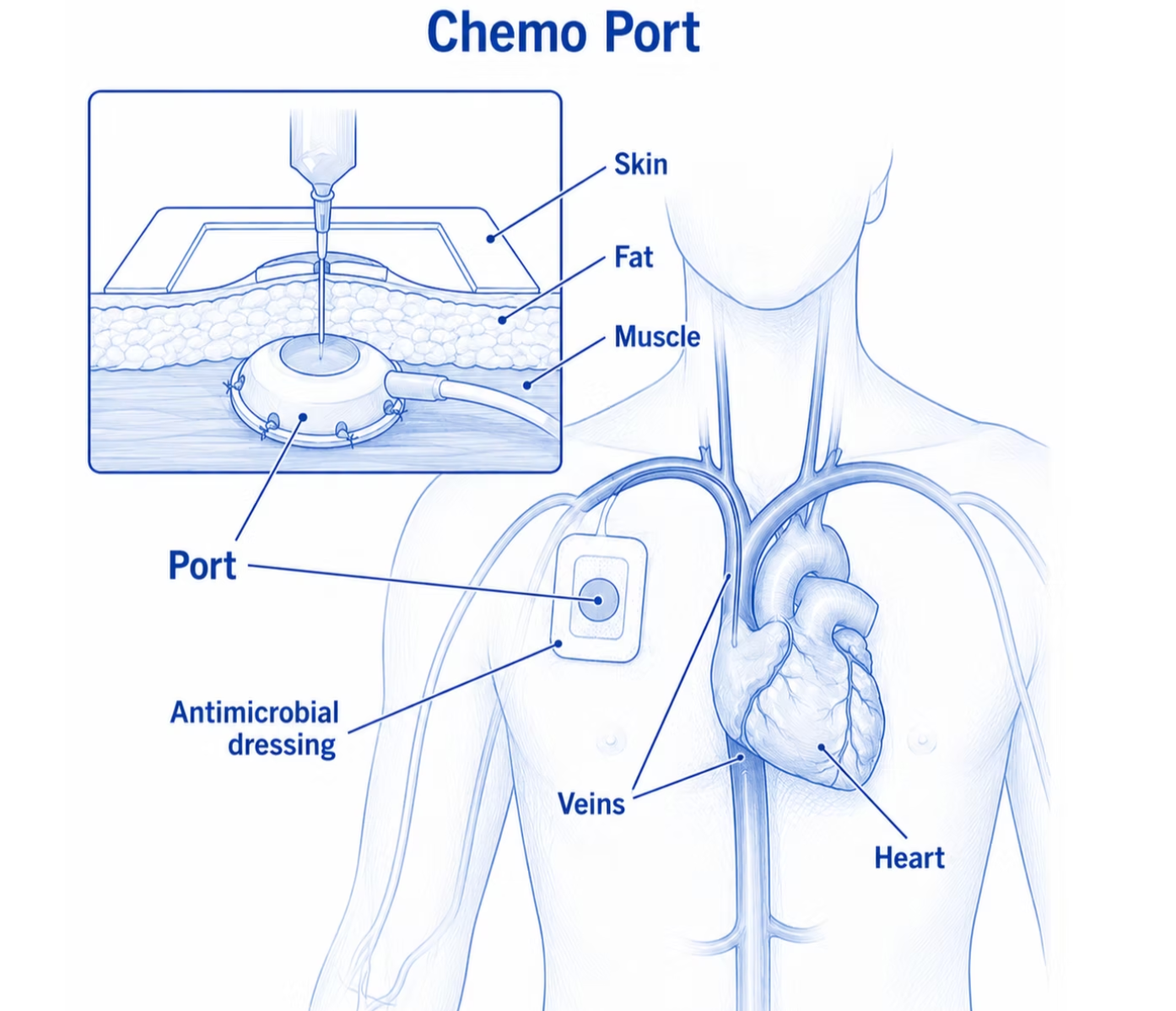
A chemoport is a small medical device placed under the skin, usually on the chest, to provide long-term access to a large vein. It is commonly used for chemotherapy, intravenous medication, blood tests, or other repeated treatments.

The port consists of a small chamber connected to a thin catheter that lies inside a central vein. It can be accessed with a special needle when treatment is needed.

What to expect

Before Your Surgery

  • Authorization should be obtained prior to surgery and will be done by the hospital or the rooms staff depending on whether you are an in- or outpatient.
  • Make sure that you have been fasting for solid foods for at least 6 hours prior to your surgery and for clear liquids or water for at least 2 hours prior to your surgery. Discuss your chronic medications with your doctor or hospital staff prior to your surgery as you usually are allowed to take chronic medications the day of surgery, barring diabetic medication the day of the procedure. If you are taking any blood thinning medication please discuss these in detail with your doctor as special arrangements need to be made for these.
  • Blood tests or clotting tests may be required before the procedure.

Day of Surgery

You will be admitted to theatre or a procedure room. The skin will be cleaned, sterile drapes will be placed, and the chemoport will be inserted.

After the procedure, a dressing will be applied. You will be monitored in recovery before discharge or transfer back to the ward.

Procedure

The procedure is performed under local anaesthesia with sedation or general anaesthesia.

A small incision is made on the chest to create a pocket under the skin for the port. A catheter is then inserted into a large vein, usually in the neck or upper chest, and connected to the port chamber. The port is secured under the skin and the wound is closed with sutures or skin glue.

An X-ray may be done after insertion to confirm the position of the catheter.

Procedure Length

The procedure usually takes 30–60 minutes.

Possible Complications

  • Possible complications include bleeding, infection, bruising, pain, catheter blockage, poor flow, catheter displacement, port malfunction, blood clots, pneumothorax, injury to nearby blood vessels or nerves, and unintended damage to surrounding structures.

Duration of Hospital Stay

  • Chemoport insertion is usually performed as a day-case procedure. Some patients may require overnight admission depending on their general condition or treatment plan.

Discharge Instructions

  • Keep the wound clean and dry. Do not remove the dressing unless instructed.
  • Avoid pulling, pressing, or manipulating the port site. Take prescribed pain medication if needed.
  • Please contact the rooms urgently if you develop fever, chills, redness, swelling, wound discharge, increasing pain, chest pain, shortness of breath, or if the port does not function properly.

Return to Activities

  • Light activity may be resumed as comfortable. Avoid heavy lifting, strenuous upper body activity, swimming, or soaking the wound until cleared by your doctor.
  • The port should only be accessed by trained medical staff using the correct needle.

Back to Work Estimation

  • Desk work: approximately 1–3 days.
    Physically demanding work: approximately 5–7 days, depending on wound healing and comfort.

Follow-Up and Results Discussion

A follow-up appointment may be arranged 5–7 days after insertion for wound review if necessary.

A further follow-up is usually arranged 10–14 days after insertion for wound assessment, suture removal if applicable, and review of port function. Histology is not usually applicable unless tissue was sent for analysis.